by Steve Selden | May 4, 2017 | Churchill Photography
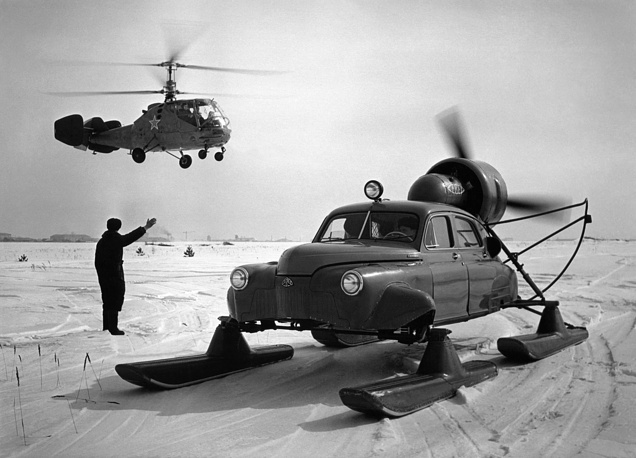
A Russian built snow vehicle from the 1950’s. A snowmobile prototype. TASS photo.
Russia has been active at exploring and settling the Arctic for many decades. This is one of the earliest vehicles to transport people in the area and quite the relic. How fun would it be to zip around the snowfields in this little number? These are not too far off from the original polar bear viewing vehicles from Churchill. The huge propeller fan on the back might be a deterrent for polar bears however!
by Steve Selden | May 3, 2017 | Videos
Polar Bears aren’t the only species that migrate to Manitoba in huge numbers! In fact, snakes are more plentiful in the far northern province of Canada. And, most of those snakes gather in a space about the size of your living room…roughly 75,000 to be more precise!
Paul Colangelo, a National Geographic grantee, recently spent time photographing the largest snake gathering in the world in the Narcisse Snake Dens of Manitoba found in southern Manitoba.
Every spring thousands of red – sided garter snakes amass inside the unique limestone caves of the region and form “mating balls” consisting of hundreds of male snakes attempting to mate with a sole female. The female twists and moves desperately to escape the pit and thus creating these balls of motion rolling on the ground around the area. The female “is desperately trying to get out of the pit,” states Colangelo, an environmental documentary photographer.
The cluster of slithery bodies seems a “frenzy, but a closer look reveals a much finer dance,” Colangelo said in his field notes. “The small males court the larger female by rubbing her head with their chins and maintaining as much contact between their long bodies as possible.”
Interacting and photographing these oft – feared reptiles brings awareness to the species and assists in fostering more appreciation for the fascinating snakes. Colangelo even goes as far as describing the snakes as “cute”. They have “puppy-dog eyes—they just don’t blink,” he quipped.
by Steve Selden | Apr 30, 2017 | Churchill Photography

Polar bear mother and cub this past fall in Churchill. Dorota Walkoski photo.
Polar bear season 2016 was filled with mother and cub polar bear sightings This shot by Great White Bear Tour’s Dorota Walkoski captures the loving affection of a mom and cub resting on the Precambrian shield. Every polar bear season in Churchill and come October 2017 we are sure there will be something different!
by Steve Selden | Mar 19, 2017 | Videos
A very rare sight to see an airlift this time of year of a mother and cub polar bear out to the ice pack. The immense amount of snow has even made travel for polar bears difficult. Mothers and cubs can emerge from their dens in March though most families are spotted further east around Wapusk National Park. This polar bear family ended up somewhat stranded in Wapusk Adventures sled – dog yard instead. Quite the happenings in Churchill this time of year!
by Steve Selden | Feb 21, 2017 | Conservation

Polarsteam during a research expedition in 2015. Mario Hoppmann photo.
Sir John Franklin and a few other early Arctic explorers would have been shocked at this announcement. Scientists are organizing one of the biggest research expeditions ever planned and the challenge is somewhat unconventional. Tentatively scheduled to sail in the summer of 2019, the 120 meter research vessel Polarsteam will spend a year drifting across the North Pole locked in sea ice. During the drift the crew of researchers from 50 institutions and 14 countries will try and discover trends leading to the dramatic climate changes we have been experiencing recently.
Camps will be set up on the ice surface and measurements and analysis data from expeditions will be taken in places not previously possible.
“The decline of Arctic sea ice is much faster than the climate models can reproduce and we need better climate models to make better predictions for the future,” said MOSAiC expedition co-leader Professor Markus Rex, at a recent American Association for the Advancement of Sciences (AAAS) meeting. “There is a potential that in a few decades the Arctic will be ice-free in summer. That would be a different world and we need to know about that in advance; we need to know is that going to happen or will that not happen?”

Arctic research sailing ship Fram in 1894.
There was one 19th century expedition that attempted this same lofty goal of drifting across the north Pole. In 1893, the Fram, lead by Norwegian explorer Fridtjo Nansen, attempted to “naturally” drift across the pole while locked in sea ice. Nansen armed with a generous budget raised by the Christiana Geographical Society as well as a personal contribution from King Oscar of Norway commissioned construction of a stout ship designed with a rounded hull to resist the crushing affects of the ice pack. Nansen left the ship after nearly a year and attempted to reach the North Pole on foot with another crew member. The story ends well and will,be covered in a subsequent post.
The Polarsteam will have no risk being trapped in ice as the technology of the day allows fro a sturdy hull unable to be crushed by the pressure of the Arctic ice. Polar bears will be the only danger for researchers on the ice and armed alert guards will be stationed at each camp along the journey.
The total cost of the German expedition is expected to cost $67 million to form a full view of the polar ice cap through the utilization of the most modern technology. Partner institutions from China, UK, Russia and the United States,will all take part in the endeavor.