This incredible photo by Roie Galitz captures a rare scene ever to be observed by humans. Persistent Polar bears spend endless hours stalking and hunting seals out on the Hudson Bay pack ice.This is one of those very special moments for a wildlife photographer and could very well be the photo of the year. Enjoy!
A mother polar bear captures a seal for sustenance and gives her a cub a valuable teaching moment Roie Galitz photo.
Some video footage shot by Natural Habitat Adventures guide Rinie van Meurs. Polar bears can dive for extended time under water though this video shows what appears to be a record dive by this particular animal. Enjoy this raw footage!
Canadian Arctic polar bears are swimming longer distances to find suitable ice in which to hunt seals and rear their young. Scientists are deeply concerned that such swims of several days duration, particularly in the Beaufort Sea, are the cause of population decline in the Arctic.
Canadian researchers tracked 58 adult female polar bears as well as 18 young male and female bears between 2007 and 2012 in the Beaufort Sea. Another group of 59 adult females in the Hudson Bay region were tracked as well. Since adult males typically remove their collars and their larger neck size generally makes it difficult to attach the collars, only the females were tracked.
Polar bears are swimming longer distances especially in the Beaufort Sea. Andrew Derocher photo.
Overall, the Hudson Bay polar bears, those including the Churchill population, rarely made long-distance swims.
However, in the Beaufort Sea, during times when sea ice dissipates, many of the polar bears made at least one swim of 50 km or more while 69 per cent did so in 2012, a record low year for ice coverage.
“More and more animals in the population are being caught in places that they just can’t stay – so the ice that they’re on is breaking up, the floes are too small, and they have to make longer distance movements to try to find better habitat,” said Andrew Derocher, a University of Alberta biologist highly involved in the study.
Researchers identified a total of 115 long-distance swims during the study, 100 of them in the Beaufort Sea, with the average distance being 92 km or thew equivalent of 3.4 days. Polar bears average swimming speed is around two km/hour. The bears have very little rest while swimming, rarely stopping and since swimming burns calories at a higher rate than walking, body fat needed for Arctic survival burns away rapidly. One female was tracked on a nine – day, 687 km swim lost her cub on the journey while also dropping 22 per cent of her weight.
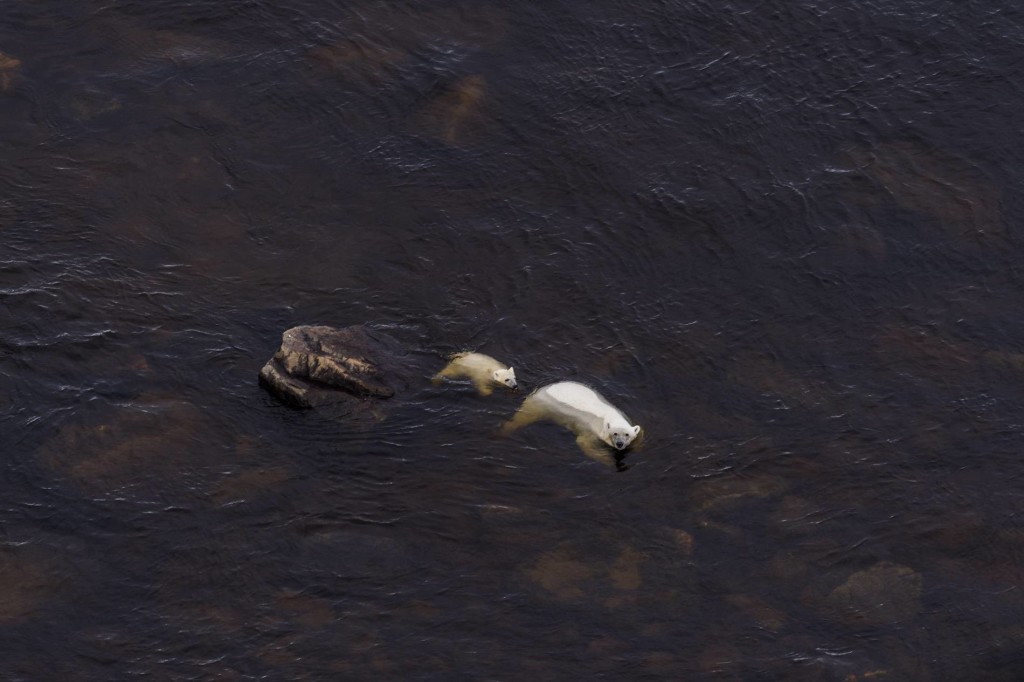
Polar bear sow and cub swimming in the Hudson Bay. John Lehmann photo.
The polar bear population in the Beaufort Sea has fallen more than 50 per cent in the past 10 years, according to Derocher. The long – distance swimming could have a huge bearing on this data. “So it is a concern that this is probably one of the factors associated with the population decline,” he said.
However, the study found no direct evidence that swimming contributes to the population decline. The polar bears tracked survived all the swims recorded in the study. Researchers were unable to track survival rates of cubs whom may have been with them other than the one extended swim referred to above. Due to hypothermia exposure to cubs, mothers with young seemed to make fewer marathon swims the researchers noted.
“Polar bears are well adapted to swimming,” Derocher said, “but of course, not all polar bears are created equal when it comes to the ability to swim.” Younger bears do not have the insulating body fat nor the stamina for prolonged water journeys.
Until the 1980’s Sea ice in the Beaufort Sea always melted close to shore as summer arrived. With the ice edge visible from land, polar bears utilize that edge during migration as a way to manage their hunting grounds. As the Arctic warms and the summer sea ice edge extends farther and farther north, polar bears are forced to swim long expanses to find stable ice.
Polar bears will need to find alternate food sources in order to survive. Andrew Derocher photo.
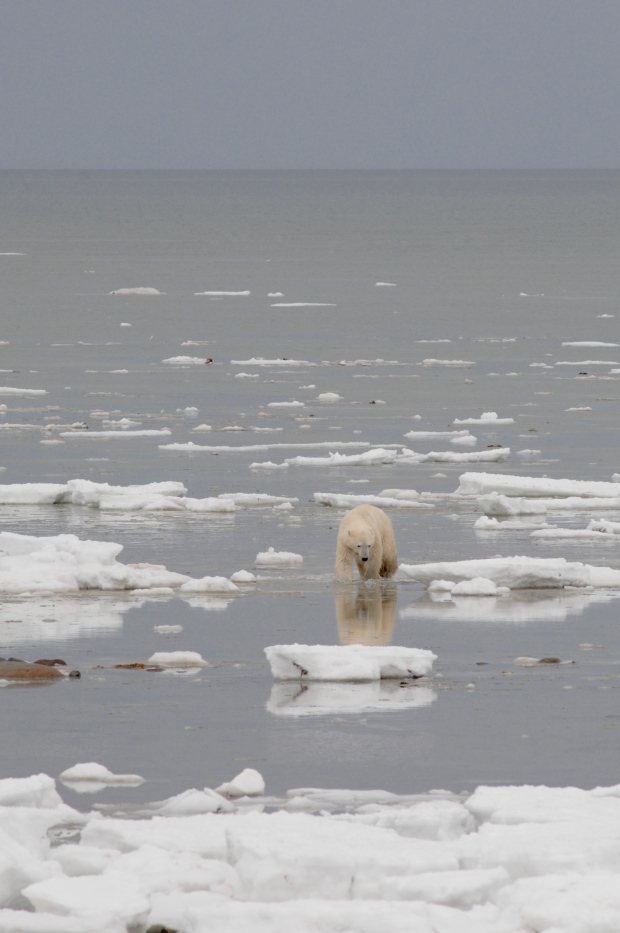
The dynamic Hudson Bay polar bear population has adapted to ice completely melting in summertime by spending long periods of time on land and in the shallows. Reliant on other food sources, polar bears in this region, including Churchill, have adapted somewhat and continue to develop ways to augment their winter food sources. Beluga whales, berries, bird – eggs and land seal – kills are more common food sources these days for the animals.
Polar bear and ravens scavenge a seal kill carcass on land in Churchill Wildlife Management Area. Brad Josephs photo.
Despite Scientists previous predictions that polar bears would need to swim farther as climate change causes chaos with Arctic sea ice, this was the first study showing enough data to actually show the correlation.
Awesome video footage of a voracious polar bear attempting to snag a beluga whale in a open lead in the ice of the Arctic. Exciting footage and evidence that polar bears will go after any creature to provide the sustenance for their high metabolism. Adaptation will be the key for these hearty animals as the Arctic ice dwindles even more due to global warming. Polar bears depend on the ice platform to hunt seals through the winter and with less ice time they must turn to protein – rich alternatives.
National Geographic wildlife photographer Nansen Weber has been going to Cunningham Inlet by Canada’s Somerset Island in the high Arctic with his cameras for 16 years. Every summer thousands of beluga whales join him for an amazing spectacle in the shallow inlet. For about a month, the beluga whales gather for what is a very social time as well as molting period and nursery time for newborns. The Cunningham River is a northerly version of the Churchill and surrounding estuaries in the southern Hudson Bay in that its’ temperatures average eight degrees F warmer than the surrounding ocean waters. The warmer water is a welcome respite for the whales and facilitates the behavior mentioned.
Weber and the whales seem to coexist in the inlet with the belugas approaching him closely as if they remember him from the year before. The drone footage of the whales, polar bears, and the incredible rugged landscape lends perspective to the massive wild region that is largely unspoiled.
That notion could be changing however with climate change and federal policy allowing research and transport throughout the Arctic. Shipping channels around the Northwest Passage are becoming more accessible with ice reduction due to warming temperatures. This will allow large ships in the region and they, with all the noise they produce, will undoubtedly have an affect on the animals echolocation faculties.
“This might be the only place on Earth you can enjoy the beluga whales like this that is still wild like it’s been for the last 500 years, but maybe it’s going to be changing. Just in my lifetime of being in the Arctic for 20 years, I’ve seen climate change. There’s new birds that are migrating up north that I haven’t seen before, there’s mosquitoes now where there shouldn’t be mosquitoes, the ice patterns and weather patterns are all weird. It’s kind of a dilemma that’s always there in the back of your head while you’re enjoying the beluga whale spectacle in front of you,” Weber says.
Weber’s videos and photos shed light on how ship traffic and resulting noise pollution may alter the beluga whale population’s migratory routes. “There has been scientific evidence that the ship traffic—the sonar—affects the communication between the belugas, so that could definitely be a problem for the future for our belugas in Cunningham Inlet.”
All of the Arctic region and all of its inhabitants will be affected with changing climate. “It’s not only about the beluga whales. I mean, we have polar bears, there’s narwhals and bowheads along the Northwest Passage, arctic char that run in the rivers. Inland you have the musk ox, the caribou that graze, all the migratory birds that fly up every summer to enjoy the short arctic summer, the snowy owls, the falcons. It’s just a huge ecosystem that’s all tied together,” states Weber.